Inlighti connects your classroom directly to real filings from the U.S. Securities and Exchange Commission. Instead of fictional case studies, students analyze the same documents traders, analysts, and investors analyze — building the document literacy, data interpretation, and critical reading skills that prepare them for careers in finance, business, and accounting.
No invented numbers. Every figure, vocabulary word, and quiz question is grounded in the real filing.
The choices a company makes with its money are the same ones students will make with theirs: what to own, where each dollar goes, how much to keep in reserve, and how much to borrow. Each skill has a ready-to-teach lesson plan built around one question.
Students weigh a company's growth, profit and risks, then decide whether they would put their own money into it and defend the choice.
In the 10-K: revenue growth, net income, earnings per share, risk factors
Students follow each dollar of sales through the company's costs to what is left as profit, then map their own spending the same way.
In the 10-K: the income statement, shown as each $1 of sales
Students compare the cash a company keeps on hand with what it spends, and connect that to building an emergency fund of their own.
In the 10-K: cash, operating cash flow, free cash flow
Students set a company's debt against its cash and income to judge whether it can pay it back, the same test a lender applies to a person.
In the 10-K: long-term debt, total liabilities, cash, interest
Each lesson plan includes an objective to paste into the Investigation Builder, so the Investigation is written around that skill. The 10-K dashboard below supplies the figures.
Finance, business, and accounting pathways are built around one idea: work with the real thing, not a simulation. Inlighti is designed around that same principle, and around adoption across a full program or district.
Every Investigation is built from a real 10-K — the same primary-source material a CTE program is expected to use, not a fictional case study.
The Career Explorer introduces students to the real roles behind a filing — CFO, auditor, attorney, analyst — a natural fit for a program's career-exploration component.
One teacher account or a full department: every class gets its own Investigations, rosters, and results, so a program can roll it out section by section or all at once.
Because every Investigation is built from a real filing instead of a fictional case study, the skills students practice are the same ones the document was actually written to test.
Practice navigating a real, formally structured company document — the same kind of reading a filing is actually written for.
Work out what the real figures in a filing mean, not numbers written to make a worksheet come out even.
Learn to tell a filing's factual disclosures apart from its persuasive, investor-facing language.
Investigate companies students already know — the brands whose products and services they buy and use every day.
The EDGAR Investigation Builder is where you create an Investigation — a guided, fact-grounded reading activity built around one real company's actual 10-K. Students get to investigate companies they already know: the brands whose products they use every day.
Find a company by name or ticker, or browse by industry, directly from SEC EDGAR.
Pick a real 10-K to build the Investigation around.
Choose the grade range, reading level, and — optionally — a specific lesson objective.
The platform writes a guided reading walkthrough, vocabulary list, comprehension quiz, and discussion prompt — all grounded in that company's real, verified numbers.
Send the finished Investigation to any of your classes in one step.
Every Investigation produces a complete teaching set — ready to edit, print, or share as-is.
Student handout for guided reading and practice.
Comprehension and calculation-based questions.
For grading, matched to the quiz.
A real, filing-grounded discussion prompt.
A take-home writing task tied to the real filing.
A complete 45–50 minute plan with objectives, warm-up, timing, and an exit ticket.
All six formats download as Word documents (.docx) you can edit, print, or share as-is.
Open any company and the dashboard lays out its annual figures from fiscal 2020 onward, taken from the 10-Ks it filed with the SEC. Teachers use it to plan a lesson; students use it to check what they read against the numbers.
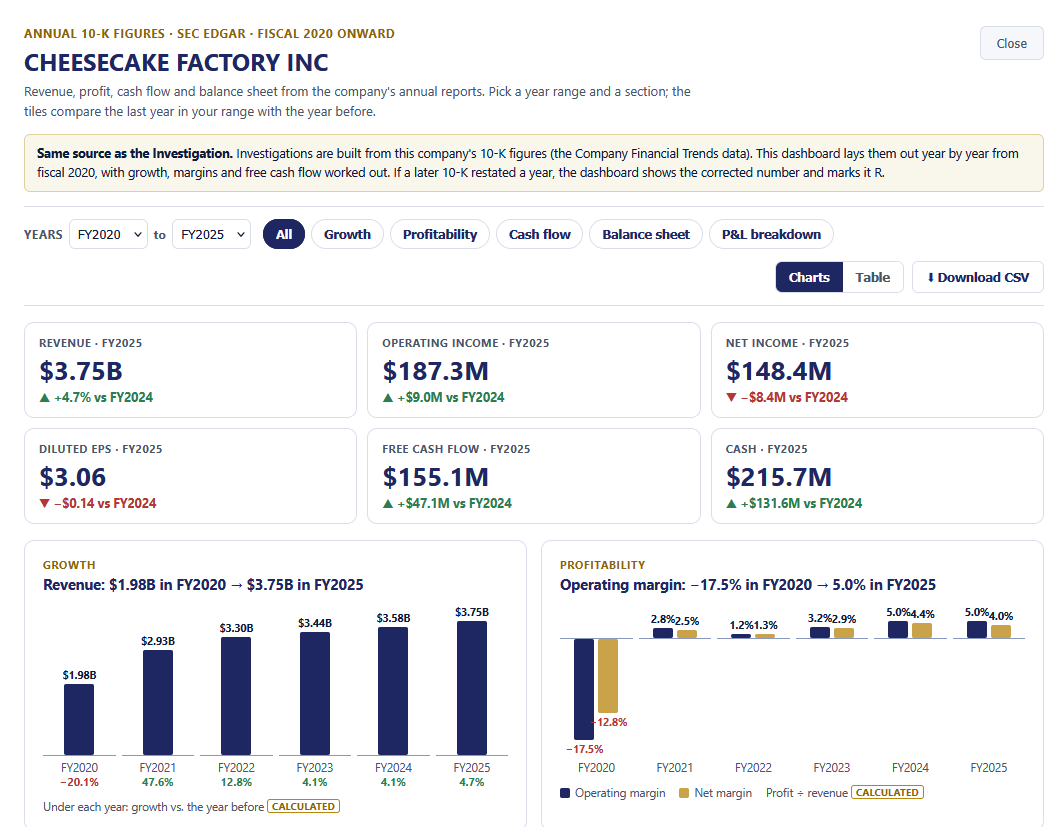
Every company a student or teacher looks up comes with an interactive, multi-year trend chart pulled directly from that company's own SEC filings — Revenue, Net Income, Cash, Total Assets, Debt, Total Liabilities, EPS, and Cash Flow. Download it as a CSV to work with in Excel or Google Sheets, no cleanup required.
Large figures are scaled to millions with clear unit labels in the header — no scientific notation, no manual reformatting.
Every value exports as an actual number, so it's sortable, chartable, and ready for formulas the moment it opens.
Each file identifies the company right in the data, not just the filename — useful once a few downloads pile up.
Pull a multi-year annual trend from 10-K filings.
Available from both the teacher's EDGAR Investigation Builder and the student's Explore Companies page.
Before a company can sell shares to the public, it has to file with the SEC. IPO Watch lists those filings as they come in, so a class can follow a company from its first filing, not only after it is a household name.
New IPO filings are picked up from the SEC every 30 minutes on weekdays, so the list a class opens is current.
A company's first filing is marked apart from later amendments, so students can tell a new arrival from an update.
Each filing is grouped by industry, and blank-check companies are labelled, so students can see which parts of the economy are raising money.
Every entry links to the company's actual filing on SEC EDGAR.
Available to teachers and students from the dashboard sidebar.
A standalone reference library, available from your dashboard sidebar, covers the career-exploration component most CTE programs already build into the year — introducing students to the people who make a filing possible, their day-to-day work, and the typical path into the role.
Signs off on the numbers and oversees the company's entire financial strategy.
Independently verifies that the filing's figures are accurate and complete.
Reviews disclosures and risk language so the filing meets legal requirements.
Builds the products and systems the filing's operating results describe.
Reads the filing professionally to judge how the company is actually performing.
You can browse the platform by industry. e.g. Agribusiness, Beverage, Clothing & Apparel, and more. The SEC maintains a reference list of well-known public companies you can browse. A direct link is also available on the EDGAR Investigation Builder page.
sec.gov/files/rules/other/4-460list.htmWe're inviting business, finance, and CTE teachers to use Inlighti with their classes.
Takes under a minute. We'll email your account details.